The DNA of Organizational Excellence: Decoding the Double Helix Model of Responsible Leadership in ASEAN
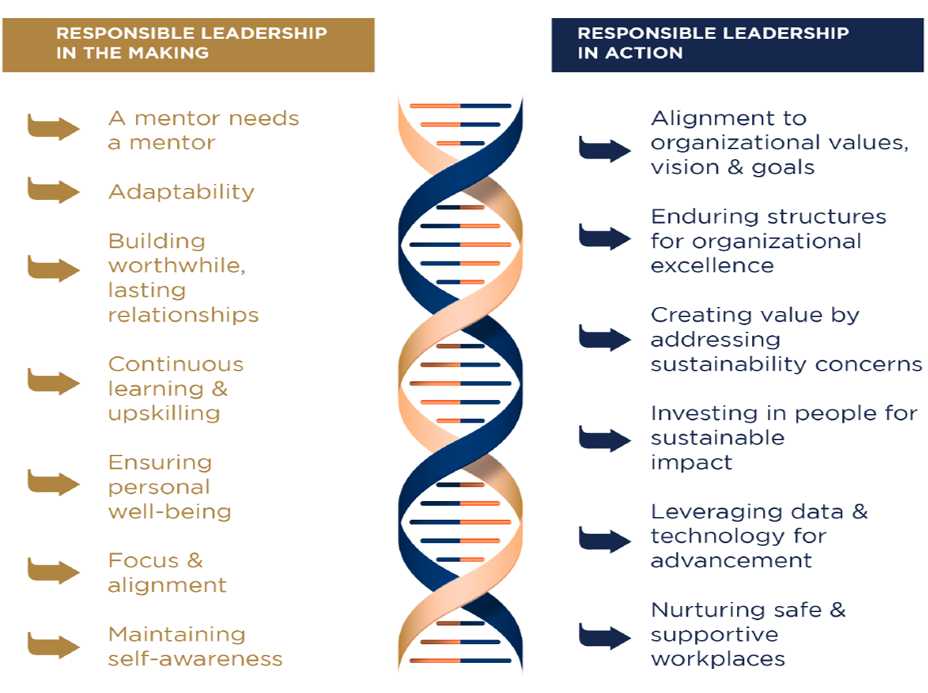
The Double Helix Model shows two integrated parts of RL and how they shape organizational excellence.

Abstract
Copyright
The ACES Institute
Kuala Lumpur, Office Block #1-2, 48 Jalan Tun Mohd Fuad, TTDI, 60000 Malaysia
Copyright © June 2026
For inquiries, contact:
The ACES Institute Secretariat
E-mail: connect@acesinstitute.org
The DNA of Organizational Excellence
Decoding the Double Helix Model of Responsible Leadership in ASEAN
The text of this publication may be freely quoted or reprinted, provided proper acknowledgement is given.
General information on the ACES Institute can be found at: www.acesinstitute.org
All rights reserved.
Key Findings
Introduction and Overview
At its core, responsible leadership is defined as a relational, stakeholder-driven approach that shifts corporate focus from a simple leader-follower dynamic to a broader leader-stakeholder perspective [1]. It is an intentional practice that balances the needs of shareholders with those of employees, communities, and the environment. In a recent landmark white paper, the ACES Institute unveiled three key pillars of ensuring long-term corporate health and organisational success. Using data from 62 top-level leaders from 7 ASEAN countries, the study conceptualised “3Rs of Organisational Excellence," a framework encompassing operational resilience, ESG readiness, and responsible leadership [2]. From the findings, resilience represents organisational capability to overcome daily operational challenges and preparedness to meet current and future trends, while ESG readiness refers to the measures organisations put in place to ensure preparedness to address ESG needs and rising demands. We argue that these two arms are glued together and made possible by effective leadership, specifically responsible leadership.
The concept of responsible leadership has been growing sharply in recent leadership literature. Although the term is older than merely two decades, the version most widely used today was introduced and popularised by Maak and Pless in 2006 and has since attracted substantial attention in leadership research and literature [3]. As such, the theory of responsible leadership has grown substantially, yet unanswered questions about the concept still remain. It continues to gain urgent importance due to the increasing need for accountable leaders in a world of increasing environmental and climate concerns, recurring corporate scandals and irresponsible behaviour [4]. To better understand how this plays out in practice, the ACES Institute conducted a thematic analysis of data from the ACES Awards, a regional annual event that draws renowned corporate leaders across Asia, primarily from ASEAN. This analysis captured this dynamic by introducing the Double Helix Model, which distinguishes between "Responsible Leadership in the making" and "Responsible Leadership in action" as the two sides of the leadership coin.
The Double Helix Model of Responsible Leadership
For a long time, mainstream corporate systems have typically evaluated leadership solely by outward metrics. Notably, standard boardroom audits continuously limit their scope to strategic milestones and mechanical implementation check-boxes, which might mask deeper flaws in organisational culture and community accountability. This focus on immediate execution metrics is a byproduct of traditional management frameworks that treat broader ethical obligations as external variables rather than core leadership benchmarks. However, a paradigm shift is evident, as evidenced by the ACES Awards dataset, which reveals a more holistic reality and approach towards leadership. From the leaders we spoke to, true leadership is deeply intertwined with an explicit commitment to fostering thriving, sustainable communities and championing stakeholder-centric ethics.
For example, multiple leaders mentioned a deliberate effort to ensure work-life balance or, as PT5, the general manager of a Bali-based hospitality and tourism establishment, put it, work-life integration. This leader argues that “Rather than separating personal and professional life rigidly, I focus on integration. I make time for family, fitness, and creative outlets—whether it’s table tennis (a passion since my youth), exploring Bali’s natural beauty, or engaging in community service through our CSR initiatives.” PT6, the director of a Malaysian-based technology and software development company, echoes these sentiments by arguing that “For me, personal and professional growth are not separate pursuits... I believe that excellence stems from a disciplined alignment of values, continuous learning, and purposeful action.” Similarly, PT7, the CEO of a Vietnamese import and export company, argued that “For me, personal and professional development are not separate aspects but rather mutually supportive and synergistic factors that contribute to sustained excellence.” Such an approach departs from productivity-focused mechanisms, in which leaders invariably focus on organisational outputs at the expense of their own and employees’ well-being. This represents the “RL in the making” arm, the “how” of being a responsible leader.
On the other end of the spectrum, leaders expressed that they try to stay up to date by ensuring continuous learning to remain relevant to industry trends. For instance, PT11, the country head of a renewable energy company in the Philippines, stated that “In my professional journey, I pursue continuous learning through exposure... Each engagement sharpens my strategic thinking and keeps me ahead in a fast-evolving industry.” Alongside receiving and giving mentorship, creating lasting personal relationships and other relational leadership approaches, these leaders demonstrated a significant tendency towards a different kind of leadership that not only focused on organisational outcomes but also created people-oriented and societal impact. To visualise this continuous, co-evolving relationship between internal cultivation and external stakeholder impact, the ACES Institute conceptualised the Double Helix Model shown in Figure 1.
Figure 1: The Double Helix Model of Responsible Leadership
Responsible Leadership in the Making
Responsible leaders are not born, but they are intentionally created. The empirical data indicate that these executives are frequently self-directed individuals driven by deep-seated personal convictions and core values about organisational integrity, which serve as an internal compass, consistently guiding them toward ethical decision-making and value-driven governance. These core values often manifest as a push to do “the right things,” which drives them towards ‘acting right' and leading with integrity for social and environmental benefits, while maintaining business sustainability through profitability. Consequently, this first strand of the double helix maps the internal strategies, developmental milestones, and deliberate choices that cultivate an identity of a responsible leader, drawing directly from the lived experiences of the regional leaders within the ACES Awards 2025 dataset.
One of the defining characteristics of responsible leaders is a deliberate commitment to holistic individual well-being, self-mastery, and continuous personal and professional growth. Historically, corporate wellness and well-being research has disproportionately focused on the workforce, heavily exploring topics such as "employee well-being or welfare" and "workplace wellness" while largely ignoring the well-being of executives. Even with explicit literature queries on executive well-being, the results overwhelmingly default to employee or workplace wellness, or explicitly frame the executive strictly as the provider or architect of everyone else's mental health. For example, a literature review of “determinants of well-being for organisational executives” shows a significant gap in search results related to executive well-being. Paradoxically, these same executives are invariably expected to devise and execute organisational strategies that protect employee welfare, while their own well-being is seldom explored. This frontline-heavy skew in workplace wellness research mirrors a broader systemic issue in organisational literature. As Voegtlin and Crane [5] note, leadership research heavily favours an 'outside-in perspective' that analyses how leaders prioritise stakeholders, while “mostly neglecting psychological mechanisms” inherent to the leaders themselves. When applied to corporate wellness, this bias reduces executives to mere resource providers for employee health, leaving a critical gap in data regarding executive burnout and well-being.
While the ACES Awards 2025 dataset does not entirely resolve this historic institutional blind spot, it uncovers a compelling regional trend: responsible leaders recognise the strategic centrality of their own well-being and take proactive, deliberate measures to sustain it. Empirical research confirms that leadership styles contribute significantly to organisational health, with relations- and task-oriented frameworks yielding a demonstrably positive impact on workforce mental health [6]. Yet, because focus on the leaders’ own well-being remains remarkably scant, there is an urgent need for deeper investigation into executive wellness ecosystems.
This gap notwithstanding, the ASEAN leaders actively acknowledged the centrality of their own welfare and well-being, detailing conscious, daily strategies to secure it. For instance, PT11, the country head of a renewable energy company based in the Philippines, observed: “I protect time for family, stay grounded in values, and lean into wellness practices that help me manage stress and stay energised.” Similarly, PT3 noted that he “emphasises well-being and work-life balance, ensuring sustained performance while fostering long-term excellence in both my career and personal development.” Interestingly, rather than chasing a traditional, rigid “work-life balance,” multiple participants advocated for a dynamic “work-life integration” (WLI). As the general manager of a large resort chain in Bali articulated, “Rather than separating personal and professional life rigidly, I focus on integration. I make time for family, fitness, and creative outlets—whether it’s table tennis (a passion since my youth), exploring Bali’s natural beauty, or engaging in community service through our CSR initiatives.” As an evolving concept, WLI is associated with the strategic blending of work and non-work domains to create institutional and personal synergy. This approach has gained significant corporate traction due to the rise of remote working arrangements and a growing desire among executives for operational autonomy [7]. While WLI offers great flexibility for leaders navigating complex, multi-faceted domains, it is important to note that its efficacy is not entirely universal [7]. Nonetheless, it serves as a vital template for future leaders seeking to mitigate burnout. This internal self-mastery directly dictates how a leader processes external market complexities. Leaders revealed that they actively try to stay focused and aligned to their goals, industry trends, and any macroeconomic dynamics. This is paired with a high degree of adaptability and flexibility, which is treated as a necessary agile response to regional complexities rather than a compromise of their goals.
As one leader revealed, “In decision-making, I try to balance long-term innovation with short-term pragmatism. I often ask: Does this move us toward a better future, and do we have the structure to sustain it?” To ensure a continuous commitment to professional upskilling and personal improvement supports this alignment, adaptability, and flexibility, responsible leadership development. Of the 62 participants surveyed, 40.3% (n = 25) explicitly highlighted self-improvement and professional growth by seeking mentorship, engaging in continuous learning, and tracking macroeconomic trends. The data reveal that for these executives, personal and professional development are not separate, isolated pursuits, but deeply interconnected, mutually supportive dynamics. For instance, PT1, the founder of a Malaysian software development company, emphasised that investing simultaneously in personal growth and external professional development is essential to “stay sharp in the ever-evolving tech landscape.” He further explained, “I make it a priority to invest in both my professional development and personal growth… stay ahead of industry trends by regularly attending conferences, reading, and seeking out mentorship from other leaders.” A veteran executive with over 27 years of experience in the hospitality industry illustrates this well by noting that balancing these dimensions is essential “not only for sustaining high performance, but also for leading with clarity, empathy, and long-term vision,” framing leadership excellence not as a static destination, but as a “continuous process of learning, reflection, and renewal.” This perspective aligns with the core thesis of the Double Helix Model: a leader’s internal growth directly dictates their external execution. Ultimately, this process requires what PT6 termed a “disciplined alignment of values, continuous learning, and purposeful action.” For future responsible leaders, these narratives offer a vital takeaway: that holistic self-cultivation is a non-negotiable anchor of corporate governance. Furthermore, as PT3 noted, maintaining this discipline requires “setting clear goals and maintaining a strong support network”—an insight that proves internal self-mastery is deeply intertwined with building lasting, external relational ecosystems.
The participants also demonstrated a noteworthy connection between self-mastery and building lasting, collaborative networks, with 14.5% (n = 9) explicitly highlighting the critical importance of building and nurturing relationships. This finding aligns with Maak and Pless’s (2006) broader conceptualisation of responsible leadership as an inherently relational, stakeholder-driven approach. The participants indicated that leading responsibly is not a solitary journey but one that thrives on an interactive ecosystem of mutual guidance and emotional support. To combat isolation and sharpen strategic thinking, responsible leaders actively engage with high-level regional networks. This is illustrated by one executive’s participation in the Singapore Leaders Network Fellowship (SGLN)—a highly selective program supported by the Economic Development Board of Singapore (EDB)—which provided structured exposure to fresh corporate strategies, executive coaches, and peer mentors. Additionally, leaders use formal networks such as Endeavour and the Strategic Asia Marketing Alliance to enforce personal accountability and broaden their perspectives. This relationship-building extends beyond strategic professional utility. Research emphasises the centrality of social relationships and connections as foundational pillars of psychological well-being and emotional resilience [8]. Several leaders highlighted that nurturing meaningful connections with family, friends, and the community provides the critical emotional support needed to maintain a balanced perspective on life. This requires a highly disciplined operational approach, with leaders applying the same organisational rigour to scheduling family commitments as to corporate obligations. This human-centric ethos is translated back into the corporate environment. Rather than viewing internal interactions through a purely transactional lens, responsible leaders intentionally foster workplace relationships "without the pressure of productivity," leveraging informal setups such as weekly check-ins or shared meals to build genuine camaraderie. This relational framework feeds a highly reciprocal learning cycle in which leaders benefit by giving back. Some found that actively mentoring emerging talent and guest lecturing forces them to "simplify, re-express, and rethink" their own institutional knowledge. Through these deeply intertwined personal, familial, and professional ecosystems, responsible leaders ensure they do not navigate their corporate journeys alone—indicating that long-term strategic alignment is fundamentally anchored in relational trust.
The "Responsible Leadership in the Making" strand of the double helix demonstrates that corporate excellence is predicated on a well-regulated internal ecosystem. Before a leader can responsibly govern an organisation, they must first master the internal disciplines of self-awareness, personal sustainability, cognitive flexibility, and relational humility. However, within the Double Helix framework, this internal cultivation does not exist for its own sake but serves as the psychological and ethical launchpad for external execution. The internal mindset shifts seamlessly from an input to a tangible output. The subsequent section explores the secondary, intertwined strand of the model: Responsible Leadership in Action, which maps how these attributes are actively operationalised to drive systemic corporate strategy, ESG integration, and regional stakeholder excellence.
Responsible Leadership in Action
In practice, responsible leadership manifests in the choices and actions leaders make in daily business operations. In its operationalisation, it is characterised by a balance among various factors, including fulfilling stakeholder desires, environmental responsibility, and business profitability and sustainability. While the conceptualisation of RL has taken various forms, it is fundamentally understood as a model of ethically oriented leadership that emphasises accountability, sustainability, and relational trust across diverse stakeholder groups [9], [10]. Consequently, it is often associated with positive outcomes in the micro, meso, and macro levels of business operations [11]. At the micro level, it is a significant determinant of various employee behavioural outcomes, including engagement, sustainable performance, career success, and lower turnover intention [12], [13], [14]. Additionally, RL fosters citizenship behaviours oriented toward the community and the environment [15], [16]. At the meso level, research shows a positive relationship between RL and organisational triple-bottom-line performance, suggesting that RL does not necessarily lead to trade-offs between financial and environmental performance. It also supports talent management and stability, and fosters an inclusive and ethical organisational climate, thereby furthering organisational sustainability [17], [18], [19]. At the macro level, RL may foster community engagement, industry innovation, and crisis management during turbulent times [20], [21], [22]. These multi-level impacts establish a benchmark for analysing how responsible leadership principles are actively operationalised across different ASEAN economies.
When viewed through the lens of the triple bottom line approach, responsible leadership emphasises all three pillars. First, ASEAN leaders revealed a noteworthy commitment to people, spanning the structuralization of social equity, the promotion of organisational justice, and the fostering of psychologically safe working environments. Internally, they report deliberate, proactive strategies to ensure employees' well-being and promote psychologically safe workplaces. One leader, a founder and CEO of a software development company in Malaysia, revealed the following:
At our company, we strive to create an inclusive environment where every team member feels welcomed and respected. This includes establishing clear policies and practices that prevent discrimination, support work-life balance, and allow flexibility for personal commitments. We also maintain open communication channels, where employees can comfortably express concerns or suggestions regarding DEI issues.
Beyond establishing these stable internal workplace frameworks, responsible action functions as a proactive future-proofing mechanism designed to ensure systemic resilience, technological readiness, and long-term ecosystem continuity. The qualitative findings demonstrate that organisations are making employee welfare and development a central part of their daily operations rather than an afterthought. This stance is powered by a focus on workplace well-being and a significant institutional commitment to continuous human capital development. In line with the RL model developed by Voegtlin et al. [23], which incorporates deliberative practices and conflict resolution through dialogue (as cited in [24]), some leaders revealed the strategies they have in place for conflict resolution and, most importantly, avoidance. One leader revealed that, for effective conflict resolution, they first “create a psychologically safe space where all voices can be heard without fear of judgment” to facilitate evidence-based decisions. Another stated that they “promote discussions that allow each party to be heard and co-create mutually beneficial outcomes,” which indicates a proactive approach to conflict resolution. Regarding employee development, leaders systematically invest in advanced upskilling through mechanisms such as in-house technical training, learning stipends, and targeted AI-literacy bootcamps. This human capital development is designed to address macro technological and ecological shifts from the ground up, where leaders actively drive workforce digital transformation alongside climate-conscious, purpose-driven mentorship explicitly designed to cultivate next-generation green leadership pipelines. Rather than keeping strategic decision-making confined to the boardroom, some responsible leaders empower junior professionals through experiential learn-by-doing frameworks that incorporate client-shadowing apprenticeships, role-playing scenario simulations, and regional talent incubators developed in direct partnership with top universities to optimise staff retention.
This internal development loops back into an ecosystem-wide thought leadership initiative and localised community empowerment. Additionally, there are deliberate steps to foster employee performance, morale, and engagement by actively ensuring their satisfaction by instituting reward programs, clear merit-based promotion paths, and continuous improvement. Several leaders commented about “human capital development and continuous improvement,” encompassing upskilling, training, and mentorship. One leader revealed that when the company adopted artificial intelligence in its operations, it implemented an AI literacy program for all employees rather than hiring new staff or requiring employees to learn on their own. This was echoed by another leader whose company “invests heavily in ensuring that their [employees] skills and industry knowledge stay relevant” through a monthly company seminar. Organisations are also implementing reward systems, as exemplified by a major Vietnamese import-export company. The company’s CEO reported that the company “proactively cultivates a culture where development is encouraged and rewarded...with recognition policies such as 'Sales Warrior' or 'Best Trainer' to only acknowledge outstanding achievements and create role models,” inspiring other young employees to strive for excellence. Research shows a positive relationship between reward systems and employee performance [25], [26], indicating that implementing these strategies may have a positive impact. Besides employee-leaning actions, responsible leadership is also revealed in the proactive efforts towards community engagement. Responsible leaders actively build an enduring social license to operate by embedding their firms within local economies, implementing localised procurement strategies, forging robust public-private partnerships with local government units (LGUs), and providing educational scholarships and community upskilling to less-privileged local populations. These all-rounded, proactive efforts to ensure all stakeholders are catered to exemplify ethical and dutiful leadership, which are key markers of responsibility.
Interestingly, the people dimension of the triple bottom line was the most talked-about of the three. Of the subsample of ASEAN-based participations analysed (N=62), more than 93% (n=58) discussed people-related initiatives, including community engagement, DEI programs in the workplace, occupational health, and workplace structures that uphold employee rights. However, only about 52% (n=32) and 29% (n=18) spoke about the environment and governance, respectively. The climate, planet, and environmental considerations and expected trends spanned clean energy use (such as electric mobility), water and marine conservation efforts, and circular economy practices. More than 14% of participants (n=9) also reported using environmental awareness-creation and education strategies to advocate for eco-friendly practices among industry players. The initiative to raise environmental awareness reflects a desire to ensure a “better future” for the environment, indicating a certain level of responsibility. This proactive advocacy demonstrates that responsible leaders do not merely view sustainability as an internal compliance metric. Instead, they act as change agents with an ecosystem-wide, internally motivated obligation to protect shared environmental resources and preserve regional prosperity for future generations [27], [28].
Practical Implications
The practical operationalisation of the Double Helix Model demands a fundamental shift in how ASEAN enterprises approach corporate governance, talent development, and executive well-being. For corporate boards and institutional investors, this model highlights the urgent need to look beyond traditional, purely financial boardroom metrics. Because long-term operational resilience is inherently linked to a leader’s internal self-mastery, standard evaluations should begin incorporating indicators of executive wellness and psychological safety as leading predictors of corporate health. Furthermore, boardrooms must actively confront the glaring regional disparity revealed in the data, where a heavy focus on social initiatives overshadows environmental and governance frameworks. Investors and boards must consciously incentivise and mandate strategic capacity-building in carbon literacy, circular economy transitions, and transparent governance structures to correct this imbalance and future-proof their organisations against evolving regulatory demands. For C-suite leaders and organisational development practitioners, the model provides a blueprint for sustainable personal and structural leadership. Leaders must abandon the illusion of a rigid work-life balance and instead deliberately design disciplined frameworks for work-life integration. By treating personal sustainability and emotional well-being as core professional responsibilities rather than afterthoughts, executives can effectively buffer themselves against systemic burnout and make decisions with greater cognitive clarity. At the organisational level, human resource teams must address the historic institutional blind spot surrounding executive mental health, recognising that a well-regulated internal ecosystem at the top is the launchpad for a healthy workforce. By embedding continuous upskilling, cross-border fellowship networks, and regional talent incubators into daily operations, ASEAN firms can cultivate a highly reciprocal learning cycle—one that successfully transitions next-generation green, digital-ready leaders from internal cultivation to purposeful, ecosystem-wide impact.
External / References
[1] T. Maak and N. M. Pless, “Responsible Leadership in a Stakeholder Society – A Relational Perspective,” J. Bus. Ethics, vol. 66, no. 1, pp. 99–115, Jun. 2006, doi: 10.1007/s10551-006-9047-z.
[2] B. Timothy, F. Ager, Dr F. Tjiptono, and Dr C. Yit Sean, “Resilience, Readiness, and Responsibility: The 3Rs of Organisational Excellence from the ASEAN Perspective.” ACES Institute, Kuala Lumpur, Malaysia, 2026. [Online]. Available: https://aces-institute.webflow.io/industry-research/resilience-readiness-and-responsibility-the-3rs-of-organisational-excellence-from-the-asean-perspective
[3] Q. Qu, P. Fu, Y. Tu, and M. Shadnam, “Responsible Leadership with Chinese Characteristics,” Manag. Organ. Rev., vol. 20, no. 1, pp. 29–59, Feb. 2024, doi: 10.1017/mor.2023.38.
[4] M. Javed et al., “What, When, and How of Responsible Leadership: Taking Stock of Eighteen Years of Research and a Future Agenda,” J. Manag. Stud., vol. 62, no. 7, pp. 3182–3219, Nov. 2025, doi: 10.1111/joms.13157.
[5] C. Voegtlin and A. Crane, “Responsible Leadership Types: Understanding the Variety and Implications of Different Forms of Leading Responsibly,” Bus. Ethics Environ. Responsib., p. beer.70107, Apr. 2026, doi: 10.1111/beer.70107.
[6] D. Montano, J. E. Schleu, and J. Hüffmeier, “A Meta-Analysis of the Relative Contribution of Leadership Styles to Followers’ Mental Health,” J. Leadersh. Organ. Stud., vol. 30, no. 1, pp. 90–107, Feb. 2023, doi: 10.1177/15480518221114854.
[7] N. I. S. Nor Sham, R. Salleh, S. S. S. Sheikh, and M. S. Saleem, “Work-Life Balance and Work-Life Integration: A Comparative Analysis through Conceptual Distinction,” Bus. Manag. Strategy, vol. 16, no. 1, p. 39, Dec. 2024, doi: 10.5296/bms.v16i1.22332.
[8] J. Holt‐Lunstad, “Social connection as a critical factor for mental and physical health: evidence, trends, challenges, and future implications,” World Psychiatry, vol. 23, no. 3, pp. 312–332, Oct. 2024, doi: 10.1002/wps.21224.
[9] C. Voegtlin, C. Frisch, A. Walther, and P. Schwab, “Theoretical Development and Empirical Examination of a Three-Roles Model of Responsible Leadership,” J. Bus. Ethics, vol. 167, no. 3, pp. 411–431, Dec. 2020, doi: 10.1007/s10551-019-04155-2.
[10] H. Wechtler and N. T. G. Nguyen, “Responsible leadership: Conceptual, operational, and theoretical issues and clarification,” Acad. Manag. Proc., vol. 2025, no. 1, 2025, doi: https://doi.org/10.5465/AMPROC.2025.13013abstract.
[11] G. N. T. Nguyen, H. Wechtler, and P.-H. Lai, “Taking Stock of Responsible Leadership Research: A Systematic Literature Review and Research Agenda,” Acad. Manag. Proc., vol. 2024, no. 1, p. 17547, Aug. 2024, doi: 10.5465/AMPROC.2024.17547abstract.
[12] H. F. Ali, A. Chaudhary, and T. Islam, “How does responsible leadership enhance work engagement? The roles of knowledge sharing and helping initiative behaviour,” Glob. Knowl. Mem. Commun., vol. 74, no. 3–4, pp. 613–629, Mar. 2025, doi: 10.1108/GKMC-03-2023-0085.
[13] C. H. Chin, S. C. Sim, J. Z. Thong, and Y. S. Chin, “Global responsible leadership traits and employee sustainable performance in Malaysia: a gender comparative analysis,” J. Glob. Responsib., vol. 15, no. 4, pp. 344–369, Sep. 2024, doi: 10.1108/JGR-04-2023-0072.
[14] M. Li, F. Yang, and M. W. Akhtar, “Responsible Leadership Effect on Career Success: The Role of Work Engagement and Self-Enhancement Motives in the Education Sector,” Front. Psychol., vol. 13, p. 888386, Apr. 2022, doi: 10.3389/fpsyg.2022.888386.
[15] A. Abbas et al., “Role of Responsible Leadership for Organisational Citizenship Behaviour for the Environment in Light of Psychological Ownership and Employee Environmental Commitment: A Moderated Mediation Model,” Front. Psychol., vol. 12, p. 756570, Feb. 2022, doi: 10.3389/fpsyg.2021.756570.
[16] S. Rao, W. K. Abdul, and Y. Kamel, “Empirical Investigation on the Effects of Culture on Knowledge Sharing and Organisational Citizenship Behaviour: Study from UAE,” Knowl. Manag. Res. Pract., vol. 20, no. 3, pp. 381–393, May 2022, doi: 10.1080/14778238.2021.1895687.
17] D. A. L. Coldwell, T. Joosub, and E. Papageorgiou, “Responsible Leadership in Organisational Crises: An Analysis of the Effects of Public Perceptions of Selected SA Business Organisations’ Reputations,” J. Bus. Ethics, vol. 109, no. 2, pp. 133–144, Aug. 2012, doi: 10.1007/s10551-011-1110-8.
[18] J. P. Doh, S. A. Stumpf, and W. G. Tymon, “Responsible Leadership Helps Retain Talent in India,” J. Bus. Ethics, vol. 98, no. S1, pp. 85–100, Jan. 2011, doi: 10.1007/s10551-011-1018-3.
[19] Z. Wang, Y. Ye, and X. Liu, “How CEO responsible leadership shapes corporate social responsibility and organisation performance: the roles of organisational climates and CEO founder status,” Int. J. Contemp. Hosp. Manag., vol. 36, no. 6, pp. 1944–1962, Apr. 2024, doi: 10.1108/IJCHM-11-2022-1498.
[20] M. Mehta, H. Sarvaiya, and A. Chandani, “Community engagement through responsible leadership in managing pandemic: insight from India using netnography,” Int. J. Sociol. Soc. Policy, vol. 42, no. 3/4, pp. 248–261, Apr. 2022, doi: 10.1108/IJSSP-06-2020-0214.
[21] P. Pounder, “Responsible leadership and COVID-19: small Island making big waves in cruise tourism,” Int. J. Public Leadersh., vol. 17, no. 1, pp. 118–131, Jan. 2021, doi: 10.1108/IJPL-08-2020-0085.
[22] M. Yildiz, N. Pless, S. Ceyhan, and R. Hallak, “Responsible Leadership and Innovation during COVID-19: Evidence from the Australian Tourism and Hospitality Sector,” Sustainability, vol. 15, no. 6, p. 4922, Mar. 2023, doi: 10.3390/su15064922.
[23] C. Voegtlin, M. Patzer, and A. G. Scherer, “Responsible Leadership in Global Business: A New Approach to Leadership and Its Multi-Level Outcomes,” J. Bus. Ethics, vol. 105, no. 1, pp. 1–16, Jan. 2012, doi: 10.1007/s10551-011-0952-4.
[24] I. Heim, B. Laker, and S. J. Tabaeifard, “Responsible leadership: A systematic literature review, theoretical framework, and future research directions,” J. Bus. Res., vol. 203, p. 115801, Jan. 2026, doi: 10.1016/j.jbusres.2025.115801.
[25] U. E. Adams, “The Effect of Reward System on Employee Performance,” Int. J. Sci. Manag. Stud. IJSMS, pp. 225–232, Jun. 2025, doi: 10.51386/25815946/ijsms-v8i3p118.
[26] A. Mazllami, “The impact of rewards on employee performance in SMEs in Polog region,” Int. Sci. J. Econ. Finance Bus. Mark. Manag. Tour., vol. 7, 2020, [Online]. Available: https://www.researchgate.net/publication/373637991_THE_IMPACT_OF_REWARDS_ON_EMPLOYEE_PERFORMANCE_IN_SMES_IN_POLOG_REGION
[27] P. Jonck, “Responsible leadership in the public sector: A sector-specific interpretation,” South Afr. J. Bus. Manag., vol. 55, no. 1, p. a4272, Apr. 2024, doi: 10.4102/SAJBM.v55i1.4272.
[28] N. Pless, A. Smit, and N. Winkler-Titus, “Editorial: Special collection on responsible leadership in emerging economies,” South Afr. J. Bus. Manag., vol. 25, no. 1, p. a5312, 2025, doi: https://doi.org/10.4102/sajbm.v56i1.5312.